





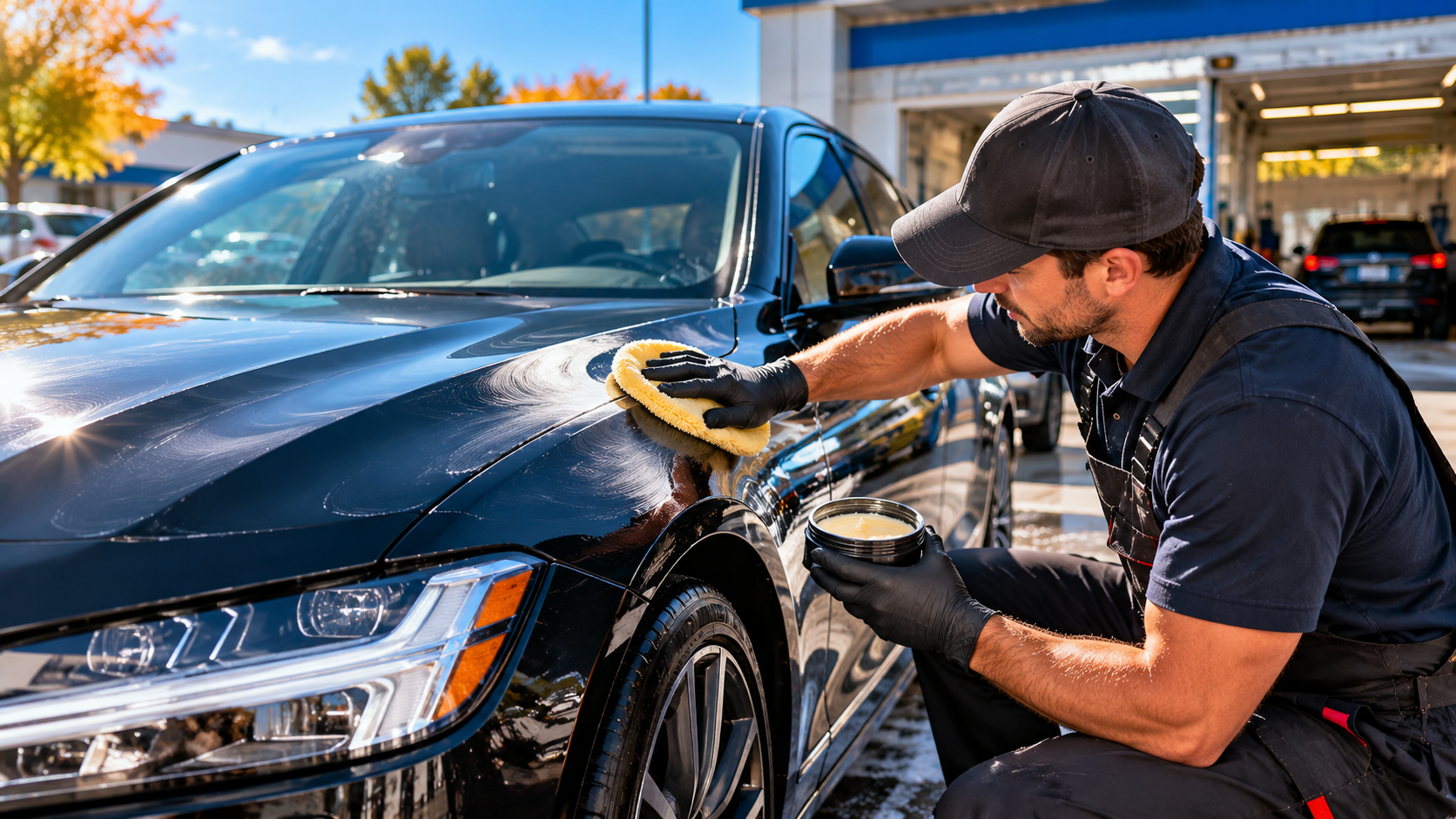
How often should you wax your car? For most daily drivers the honest answer is somewhere between every month or two and every six months, depending on the type of wax, the weather and where the car spends its nights.
That is a wide range, and a single number never fits every driver. A garaged commuter and a car that sits under a tree through a New England winter are asking wax to do very different jobs.
Pick your wax, factor in where you park and what season it is, and you have a schedule that fits your car. A few quick signs will tell you when the last coat has worn out.
How often should you wax your car? The baseline
When people ask how often should you wax your car, the best answer starts with the wax itself, because the product sets the ceiling. Jalopnik’s guide to waxing frequency offers these rough estimates for how long each type lasts:
| Wax type | Typical lifespan |
|---|---|
| Carnauba | About 4 to 8 weeks |
| Liquid | About 8 weeks |
| Synthetic or polymer | About 3 to 4 months |
| Paste | About 3 to 6 months |
Estimates from Jalopnik. Your results will vary with weather, parking and washing habits.
The same source suggests a baseline of at least two coats a year, one before summer and one before winter, and says waxing about four times a year gives noticeably better protection for the clear coat. AAA Northeast puts the general lifespan of a coat at three to six months, which lines up with the middle of that range.
Waxing more often will not hurt the paint. It simply costs you more time, so the goal is to wax often enough to stay protected without turning every weekend into a project.
What changes how often you should wax
Think of the baseline as a starting point. Three habits decide how often you should wax your car in real life, pushing your schedule shorter or longer.
Where the car is parked
A car that lives in a garage faces far less sun, rain and grime than one parked outside. Cars exposed to UV, wind, rain and snow all day need wax more often than garaged ones, so outdoor cars should lean toward the short end of the range.
How and where you drive
Highway miles, road salt and long commutes all wear a coat down faster. A car that mostly makes short, dry local trips will keep its protection longer.
How often you wash it
Washing protects paint, but frequent washes still wear wax down over time, especially if you use strong soaps. If you wash weekly, plan to wax closer to the short end of the range. Our seasonal washing guide can help you set the washing side of that rhythm.
How often should you wax your car in Connecticut?
Connecticut has four real seasons, and each one asks something different of your paint. A schedule built around them is easier to remember than a calendar count.
So how often should you wax your car in Connecticut? A good starting plan is two coats a year, with up to two more if the car lives outside:
- Fall: the essential coat before cold weather arrives
- Spring: a refresh after winter salt is washed away
- Early summer: an optional touch-up for outdoor cars facing strong sun
- Mid-winter: skip it unless you have a heated garage, and focus on washing
Spring
Winter leaves salt and grime behind. Give the car a thorough wash once the roads are clean, then wax so the paint is protected before summer sun arrives.
Summer
Strong sun, bird droppings and tree sap are the main threats. If your car sits outside, a mid-summer touch-up coat is worth considering.
Fall
This is the most important coat of the year. Waxing before cold weather gives the paint a protective layer going into winter, and it is much more pleasant to apply on a mild day than in a freezing driveway.
Winter
Cold temperatures can make wax harder to apply and cure properly, so winter is a time to keep up the washing rather than start a project. Our post on winter car wash services explains why regular washes matter when salt is on the road.
Branford Car Wash and Express Lube · Branford, CT
Want a fresh coat without the guesswork? Call Branford Car Wash and Express Lube to ask about an Express Hand Wax.
Signs your car needs wax again
You do not have to rely on the calendar alone. Your paint will tell you when protection has faded.
- Water stops beading. Wax creates a layer that makes water bead up, so if there is little to no beading when it rains, it is time to wax again.
- Water sheets off in flat patches instead of forming round droplets.
- The paint looks dull even right after a wash.
- Dirt, dust and bugs seem to stick harder and take more scrubbing to remove.
- The surface feels slightly rough or dry to the touch after washing.
The water test is the easiest. Wash the car, let a little water sit on the hood, and look at the shape of the droplets. Tight, round beads mean the coat is still working. Flat, spreading water means it is time. Repeat the test every month or so, and especially after a long stretch of winter driving, so the schedule follows the paint instead of a guess.
Doing it yourself or letting a pro handle it
Whichever answer to how often should you wax your car you settle on, someone has to do the waxing, and you can choose to do it yourself or hand it off. The Express Detail Services page at Branford Car Wash and Express Lube lists an Express Hand Wax that takes 30 minutes or less, is done while you wait and includes a car wash. The page says the result lasts for months and months, which fits neatly into a seasonal plan.
If you want the full case for why regular waxing is worth the effort, our earlier post on the benefits of regular car waxing covers it. Here, the takeaway is simpler: pick your season, watch the water, and wax before the paint asks for it.
Frequently asked questions
How often should I wax my car?
Most daily drivers do well with a fresh coat every three to six months, and more often with short-lived waxes like carnauba. Outdoor parking, salt and heavy driving all push you toward the short end of that range.
How long does car wax last?
It depends on the product. Jalopnik estimates carnauba at about 4 to 8 weeks, liquid at about 8 weeks, synthetic or polymer at about 3 to 4 months and paste at about 3 to 6 months. Weather and washing habits can shorten or stretch those numbers.
Does waxing a car in winter help?
A wax coat applied before winter helps water bead off and makes salt and road grime easier to wash away. Cold weather can make application harder, so the best plan is to wax in fall and keep up regular washes through the winter.
How do you know when your car needs wax?
Check how water behaves after a wash or a rain. If it no longer beads into round droplets, or the paint looks dull and collects dirt quickly, the wax has worn thin and it is time for a new coat.
Ready to put a schedule on your calendar? Contact Branford Car Wash and Express Lube or stop by 938 W. Main Street in Branford, CT. We are open Monday to Saturday from 8 a.m. to 6 p.m. and Sunday from 9 a.m. to 4 p.m.
Latest Post
-
 How Often Should You Wax Your Car? A Seasonal Guide for Connecticut Drivers
November 12, 2026
-
 How to Wax a Car: Step-by-Step Guide for a Lasting Shine
November 5, 2026
-
 Underbody Car Wash: Why Cleaning Beneath Your Vehicle Matters More Than You Think
October 6, 2026
